- April 3, 2026
- Admission
Imagine a world with all courses, labs, businesses connected together as one very large conceptual idea called ‘artificial intelligence.’ The vision of an entire university focused solely on Artificial Intelligence (AI) has now come true. UAi is India’s first full-fledged university specifically dedicated to studying AI; there are only two other universities in the world that currently exist for studying AI as their primary area.
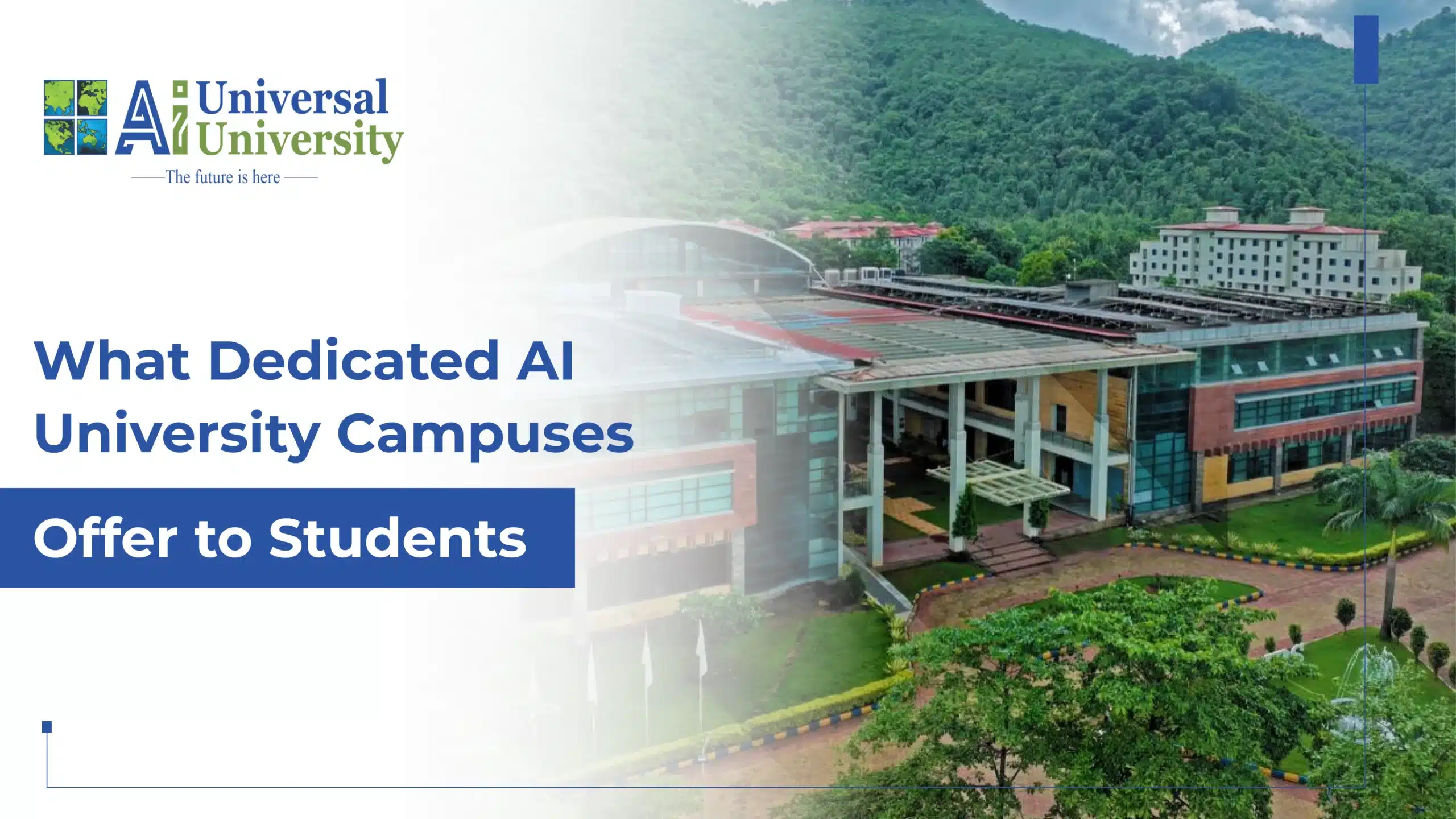
The Universal Ai University (UAi) is situated on a campus of more than 40 acres of beautiful land in Karjat near Mumbai. Originally founded in 2009 (as Universal Business School), it became reintroduced officially as an AI university (UAi) as a result of the passage of The Universal Ai University, Karjat Act, 2022. The UAi’s establishment is a key factor in redefining what a university devoted to AI can look like in terms of the types of degrees and areas this new higher education system encompasses.
Academic Design: AI Core, Electives and Domain Integrations
The first thing that sets an AI university apart is how it builds its curriculum. At UAi, AI is not a single elective buried inside a traditional CS programme — it is the thread that runs through every discipline.
There are many undergraduate, postgraduate and doctoral programs available in various fields, including AI, data science, sound engineering, music production, psychology, design, and management. One outstanding aspect of the university is the integration of AI into non-technical fields. For example, the Universal Ai University (UAi) offers India’s first AI-integrated programs in music and sound technology, with a B.Tech in sound engineering and a B.A. in music and audio production.
Here is a quick look at the programme spread:
| Level | Programmes Available |
| Undergraduate | B.Tech (AI & ML, Data Science, Sound Engineering), BBA, B.Des, BA (Hons.) |
| Postgraduate | MBA (multiple specialisations), Executive MBA |
| Doctoral | Ph.D. |
The curriculum uses 80% experiential learning to provide students the opportunity to apply knowledge rather than to memorise it; UAi has a strong emphasis on critical thinking and practical learning as opposed to rote learning. The electives also allow students to use artificial intelligence in the areas of green finance, international business and design, making it so that the specialized curriculum for AI serves as a true differentiator within UAi.
Labs and Compute: GPUs, Datasets, Simulation & Tooling
A strong AI university campus needs more than classrooms. It needs the kind of infrastructure that lets students actually experiment with AI at scale.
At UAi, the campus is built with this in mind:
- Tech-enabled smart classrooms that support interactive and simulation-based learning
- IoT and engineering labs where students build real-world projects — from smart fire alarms to waste-segregation systems
- High-performance computing access, with the campus even referencing quantum computing exposure as part of the technology experience
- A fully Wi-Fi-enabled residential campus that supports round-the-clock learning
First-semester B.Tech students have already developed IoT-based projects such as rain-detection alarm systems and smart waste-segregation tools — a clear sign that the lab culture encourages hands-on building from day one.
The campus also runs an Experiential Learning Corporation (ELC), where students get hands-on business, leadership, and entrepreneurial experience by working for a private limited company right on campus. This kind of embedded, live-business experience is something you simply will not find at a traditional tech college.
Research Culture: Projects, Publications, Seminars
For students who want to go beyond coursework, UAi offers a growing AI research education ecosystem.
Students can engage in research projects, conferences, and benefit from a dedicated incubation hub on campus. The university’s innovation culture is driven by structured programmes:
- Universal Innovation Council (UIC): Students propose and implement innovations across academic processes and pedagogy
- Young Ideas programme: Student innovations can receive seed funding from venture capitalists
- Case Blazer: A 100-hour case study programme that prepares students for real corporate competition
- Rush4Rush: India’s first inter-collegiate business adventure festival, developed and executed entirely by students
On the global research front, UAi and Qatar’s Arab Center for Artificial Intelligence signed an MoU to establish an AI research centre in Doha and introduce specialised training programmes addressing the rising demand for AI expertise. This kind of international research collaboration signals that UAi is building credibility well beyond its campus boundaries.
Seminars by industry leaders (referred to as CEO Talks) are also baked into the curriculum, especially for the MBA and Executive MBA programmes, providing leadership insights and hands-on capstone projects involving real-world business challenges each trimester.
Industry Links: Internships, Applied Labs, Capstone Ties
One of the strongest arguments for choosing a specialised AI university over a general tech school is the quality of industry connections. UAi was built with this in mind — it describes itself as a university created “By Industry, For Industry” and is endorsed by 60 global CEOs.
Key industry integration features include:
- Capstone projects tied directly to business problems sourced from industry partners
- CEO Talks every trimester bringing real decision-makers into the classroom
- Global internship pathways — students on partner programmes can intern in Paris or San Francisco, with the option to convert internships into full-time jobs or extend them under the Optional Practical Training (OPT) programme in the USA
- Placement support with over 229 companies participating in recruitment drives — UAi recorded 1,230 interviews from domestic and international companies for its MBA students in 2023
A strategic partnership with Florida State University’s Jim Moran College of Entrepreneurship focuses specifically on the intersection of artificial intelligence and entrepreneurship, giving students exposure to global startup thinking alongside AI tools.
The highest salary package ever recorded at UAi? ₹1.01 Crore — a number that reflects the market value the institution’s graduates are commanding.
Skills and Outcomes for Graduates of AI-Focused Campuses
What does a student actually walk away with after four years at an AI university? The answer goes beyond a degree.
Graduates from UAi’s programmes are equipped with:
- Technical skills: Machine learning, data science, neural networks, AI model deployment, and domain-specific AI applications
- Business intelligence: AI-integrated MBA programmes ensure even management graduates understand how to lead AI-driven organisations
- Entrepreneurial mindset: Through ELC, Young Ideas, and startup-linked programmes, students learn to build, not just study
- Global exposure: International campuses in the UK, France, Bulgaria, and the USA offer students a chance to study and work abroad
- Soft skills: Leadership, communication, ethical reasoning, and cross-cultural collaboration — all strengthened through the 24/7 residential model
EMBA participants at Universal Ai University (UAi) have reported a 20–50% salary increase, expanded career opportunities, and promotions after graduating — concrete proof that AI-integrated education translates into real professional gains.
How AI Universities Differ from Traditional Tech Schools
Here is a side-by-side look at how a dedicated AI university differs from a conventional engineering or technology college:
| Feature | Traditional Tech College | AI University (like UAi) |
| Curriculum focus | Broad CS/engineering | AI-embedded across all disciplines |
| Learning approach | Theory-heavy | 80% experiential, project-based |
| Industry integration | Placement cells | CEO talks, capstones, live company on campus |
| Research access | Limited for undergrads | Innovation councils, incubation hubs, VC funding |
| Global exposure | Occasional exchange | Formal global campuses and internship-to-job pathways |
| Ethical AI | Optional elective | Embedded in vision and programme design |
| Residential model | Mostly day schools | Fully residential — learning happens 24/7 |
The biggest difference is not just the curriculum — it is the philosophy. A dedicated AI university is built around the assumption that every future professional, regardless of field, will need to understand and work alongside AI. A traditional tech school still treats AI as one branch of computer science among many.
Conclusion
India’s rise as a worldwide leader in artificial intelligence (AI) is being driven by more than just its many start-ups and information technology companies; this has evolved out of an extensive effort being made on college campuses such as the Universal Ai University (UAi). UAi combines an AI-focused academic program with advanced computing and laboratory facilities along with an active research community, and strong partnerships with firms in the AI industry. Situated on a purposefully constructed green campus in the suburbs of Mumbai, UAi’s goal is to give students who want more than just a regular degree – to graduate as fully prepared graduates for an AI world.
So what actually makes UAi so much different than any other school? A traditional college cannot create a group of individuals whose experience in their educational environment is that of viewing everything they do or see through an AI-based lens.
FAQs
- Do AI universities only teach AI, or broader CS too? UAi covers much more than just AI. Its programmes span business management, design, liberal arts, sound engineering, music, law, environmental science, and international diplomacy — all with AI embedded into the curriculum. So students get both AI depth and disciplinary breadth.
- What kind of research exposure can undergrads get? Undergraduates at UAi can participate in the Universal Innovation Council, pitch ideas through the Young Ideas programme for VC seed funding, and work on IoT and AI lab projects from their very first semester. Research is not reserved for postgraduate students here.
- Are industry internships embedded in coursework? Yes. Internships are a structured part of the programme, especially for global track students. Through international partnerships, students can intern in cities like Paris or San Francisco, with pathways to convert those internships into full-time roles abroad.
- How is responsible/ethical AI handled? UAi’s stated vision is to develop “ethical, innovative, global, and responsible leaders.” Responsible AI is not an afterthought — it is part of the university’s core philosophy, reflected in how programmes are designed and how students are mentored to think about the real-world impact of the tools they build.
- How should students compare an AI campus vs a regular tech college? Look beyond rankings and fees. Consider the learning model (experiential vs lecture-based), the industry integration (is it built in or bolted on?), the research culture (can undergrads actually participate?), and the global exposure available. If you want AI to be central to your education — not just one course on a syllabus — a dedicated AI university campus is worth serious consideration.